


Luxury chic
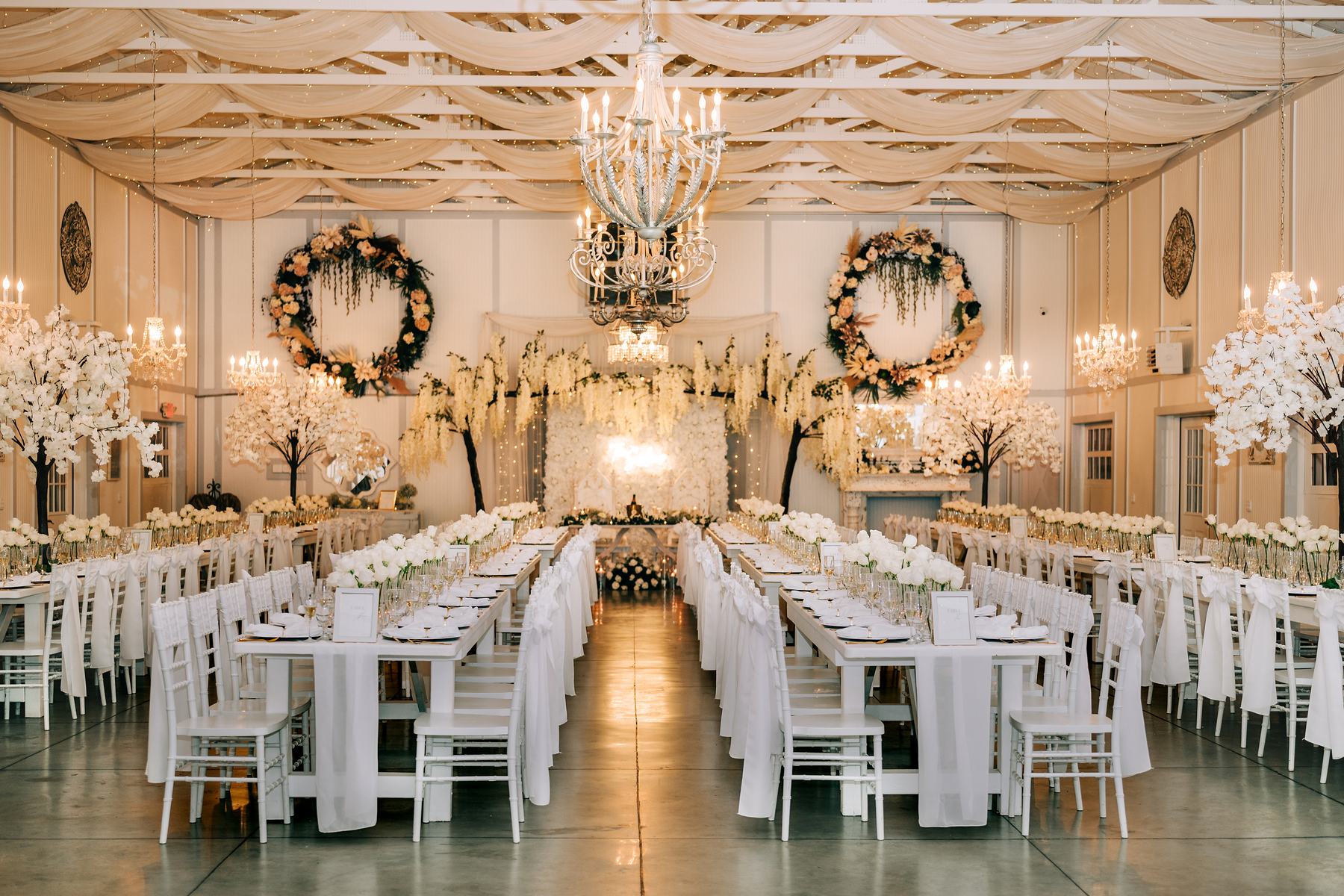
The Barn
Best for: Full guest lists, evening receptions, dancing until the end
*The Barn can accommodate up to 200 guests maximum, and a $50 per person charge will be applied at any party size over 150.
Understanding All-Inclusive Pricing
More inclusions don’t automatically make a better wedding. Here’s how our packages are built, why bigger isn’t always the right choice, and how to spot a real all-inclusive quote.
4.9 · 1,400+ Google reviews Three venues, one estate Booking 2027 & 2028
What all-inclusive actually means
Ask ten venues what ‘all-inclusive’ means and you’ll get ten different answers. Some bundle the room and tables, then charge separately for catering, bar service, a coordinator, and a cake. By the time the invoices stack up, the number on the contract has little to do with the number on the final bill. At Saxon Manor, all-inclusive means the quote is the wedding: ceremony, reception, design and coordination, in-house chefs, bar and event staff, a photographer, a DJ, a tiered cake with tasting, and an officiant, all inside one price. You can see the full list on what’s included. This page isn’t here to sell you on more. It’s to explain why more items in a package doesn’t automatically mean a better wedding.
Our three spaces price differently because they solve different problems, not because one is a step up from another. The Barn and the Garden Room each hold up to 150* guests and run $15,000 to $21,000 all-inclusive. BoHo holds up to 55 guests and runs $9,500 to $12,500. Neither is the ‘basic’ option and neither is the ‘deluxe’ one. A couple with 40 guests who books the barn because it feels grander isn’t buying a better wedding — they’re buying square footage they don’t need. The full room-by-room breakdown lives on our pricing page. Here, the question isn’t which room costs more. It’s which room fits the wedding you’re actually planning.
*The Barn can accommodate up to 200 guests maximum, and a $50 per person charge will be applied at any party size over 150.
Plenty of venues sell ‘all-inclusive’ as a floor, not a ceiling. The quoted number gets you in the door, then a planner walks you through upgrade tiers: a better bar package, a longer photography block, a second entrée, uplighting, a bigger dance floor. Each upgrade sounds small. Together they can add thousands to a number you thought was final. That’s not necessarily dishonest — it’s a different business model, built around a low headline price and a long list of extras. It works for some couples. It doesn’t work for couples who want to know, on day one, exactly what their wedding costs. If that’s you, ask every venue you tour one question: is this the final number, or the starting one?
We built our packages around a simpler idea: the price you’re quoted is the wedding you get. There’s no tiered bar menu waiting behind door two, no per-hour photography add-on you discover in month four of planning. The chefs, the DJ, the officiant — they’re priced in from the first conversation. That doesn’t mean you can’t personalize the day. It means personalizing it doesn’t require renegotiating the contract. When you sit down with our team, the number you hear is the number you’ll see on the invoice, minus whatever you choose to spend on things outside the package, like a specialty rental or an extra hour of open bar.
Why bigger isn’t automatically better
The most common way ‘more’ backfires is guest count. A bigger room can hold more people, so couples invite more people, and the wedding gets more expensive — not because the venue raised its price, but because catering, rentals, and bar service scale with headcount. Fifty extra guests on a per-plate catering line can outweigh the difference between two rooms entirely. Decide on your list before you pick a room for its capacity. If you’re planning for 60, a room built for 150 will cost you in scale you don’t need. Our BoHo space exists for exactly this: a real all-inclusive wedding for up to 55 guests, priced for that size, not scaled down from a bigger one.
The second way ‘more’ backfires is vendor stacking. Every additional vendor a package advertises is one more contract, one more point of contact, one more thing to coordinate on the day. A package with a photographer, a videographer, a band, a quartet, a photo booth, and a food truck sounds generous. It’s also six schedules that have to line up and six invoices buried inside one quote. Some couples want all of that, and that’s fine — it’s their day. But ‘more vendors included’ isn’t the same as ‘better day guaranteed.’ It’s more moving parts. The question worth asking isn’t how many vendors are in the package. It’s whether they’re vendors you’d hire anyway.
There’s also a plainer version of the problem: money spent on inclusions you won’t use is money not spent on the parts of the day you actually care about. A package padded with a champagne wall, a light-up monogram sign, and a five-tier cake for forty guests is still one number, but it’s a number built around inclusions, not around your wedding. If you’d rather put that budget toward a longer reception, better food, or just a lower total bill, a padded package works against you even at a fair price. The honest move is to ask what you want the day to feel like before deciding what goes into the quote — not the other way around.
We keep our packages built around what a wedding actually needs to run well — a ceremony and reception space, a design and coordination team, chefs, bar and event staff, a photographer, a DJ, a cake, and an officiant — and we leave the rest to you. Florals are not part of the package. Our on-site sister company, Enchanted Design & Floral, builds them separately, priced on their own terms, not folded into a bigger number to make the package look more generous. That’s a deliberate choice. It keeps the base price honest and lets you decide, item by item, where the extra spending — if there is any — actually goes.
Matching the package to the day
Saxon Manor has three spaces: the Barn, the Garden Room, and BoHo. The comparison below lays out capacity and pricing for each, and it’s worth reading closely before you fall for a room because of how it photographs. What the chart can’t tell you is which space fits your wedding, because that depends on your guest list and the kind of day you want, not on which room carries the higher number. A 150-guest Barn wedding and a 55-guest BoHo wedding are both true all-inclusive weddings at the same venue, priced for their actual scale. Picking the pricier room because it seems like the upgrade is exactly the ‘more isn’t better’ mistake this page is about.
BoHo also does double duty beyond the wedding day itself. If you want a rehearsal dinner, a bridal shower, or a post-wedding brunch in the same style as your ceremony, that space runs $2,000 to $3,000 for those events. It’s a smaller commitment than adding another full wedding-sized event to your weekend, and it means your rehearsal dinner doesn’t have to happen somewhere that has nothing to do with the rest of your celebration. Whether that’s worth it to you is a real budget decision, not an obvious one — which is the whole point. Every add-on, ours included, should be judged against what it actually gives you, not how good it sounds on a checklist.
One reason we can hold a quote steady from booking to wedding day is that weddings are the only thing we do. We’re a family-owned venue with three-room Bridal Suites on site, not a banquet hall that also hosts corporate events and treats weddings as one more rental category. That focus is what lets our team build a package around what actually matters on a wedding day, instead of a generic list of amenities meant to cover every kind of event that might book the room. It’s also why the answers you get on a tour tend to be specific instead of vague — the people answering your questions do this every week, for this exact kind of event.
If you’re comparing us against other venues, bring your guest list and your must-haves, not just a budget number. Ask what’s included, ask what isn’t, and ask whether the quote you’re given is the number you’ll actually pay. We’ve written up a longer list of questions worth asking any venue at questions to ask a wedding venue, and a breakdown of how all-inclusive pricing compares to booking every vendor separately at all-inclusive vs. a la carte. The right amount of ‘included’ is the amount that matches your wedding, not the longest list on the page.
Compare the three spaces
Luxury chic
Best for: Full guest lists, evening receptions, dancing until the end
*The Barn can accommodate up to 200 guests maximum, and a $50 per person charge will be applied at any party size over 150.

Illuminated
Best for: Daytime ceremonies, garden views, photography

Micro-wedding
Best for: Under 55 guests, intimate ceremonies, second marriages
Deciding what your wedding actually needs
Here’s a practical way to test any all-inclusive quote, ours or anyone else’s: list what’s actually included, then ask what happens to the price if your guest count changes, if you add an hour, or if you want a different bar package. If the answer involves a call to a sales team and a revised proposal, the number you were quoted was never really the price — it was an opening one. If the answer is a fixed range tied to guest count, you’re looking at something closer to a real number. Our Barn and Garden Room run $15,000 to $21,000 for up to 150* guests; BoHo runs $9,500 to $12,500 for up to 55. Those ranges move with guest count and season, not with negotiation.
We’re at 103 S Saxon Ave in Brooksville, about 45 minutes from Tampa and 90 minutes from Orlando, which makes the drive workable for guests coming from either direction without turning the wedding into a travel weekend. We’re currently booking 2027 and 2028 dates, which gives most couples real room to plan without rushing a decision. The best way to judge whether a package fits your wedding is to walk the rooms and ask your specific questions in person, not to compare brochures. Call 813-909-3414 or use our contact page to set up a tour, and bring your guest list and must-haves, not just the number you’re hoping to hit.
Personalizing a true all-inclusive wedding doesn’t mean adding line items until the quote balloons. It means using what’s already built into the price well. Our in-house florist, Enchanted Design & Floral, designs something specific to your wedding, not a generic centerpiece pulled from a catalog. The same goes for the menu our chefs build, the playlist our DJ runs, and the ceremony our officiant leads. The inclusions aren’t a floor you build up from with extras — they’re meant to be the whole day, done well. If you want something genuinely additional, like an upgraded bar package, you can add it deliberately, at a price you see in advance.
The reason ‘more isn’t always better’ matters is simple: a wedding budget is a fixed amount of money asked to do a specific job, and every dollar spent on an inclusion you didn’t need is a dollar not spent on what actually mattered to you. A true all-inclusive package should make that math easier, not harder — one price, a defined list, and no guessing about what happens next. That’s what we’ve built across all three of our spaces, and it’s why the number you hear from us at the start of planning is the same number you’ll see at the end. If that’s the clarity you’re planning around, we’d like to show you the rooms.
Keep reading
On the number
Booking 2027 & 2028
A tour takes about an hour. You’ll see all three venues, the Bridal Suites, and leave with real pricing for your date and guest count — not a brochure.
103 S Saxon Ave., Brooksville, FL 34601 · 45 minutes from Tampa · 90 minutes from Orlando
