

Decor & Atmosphere
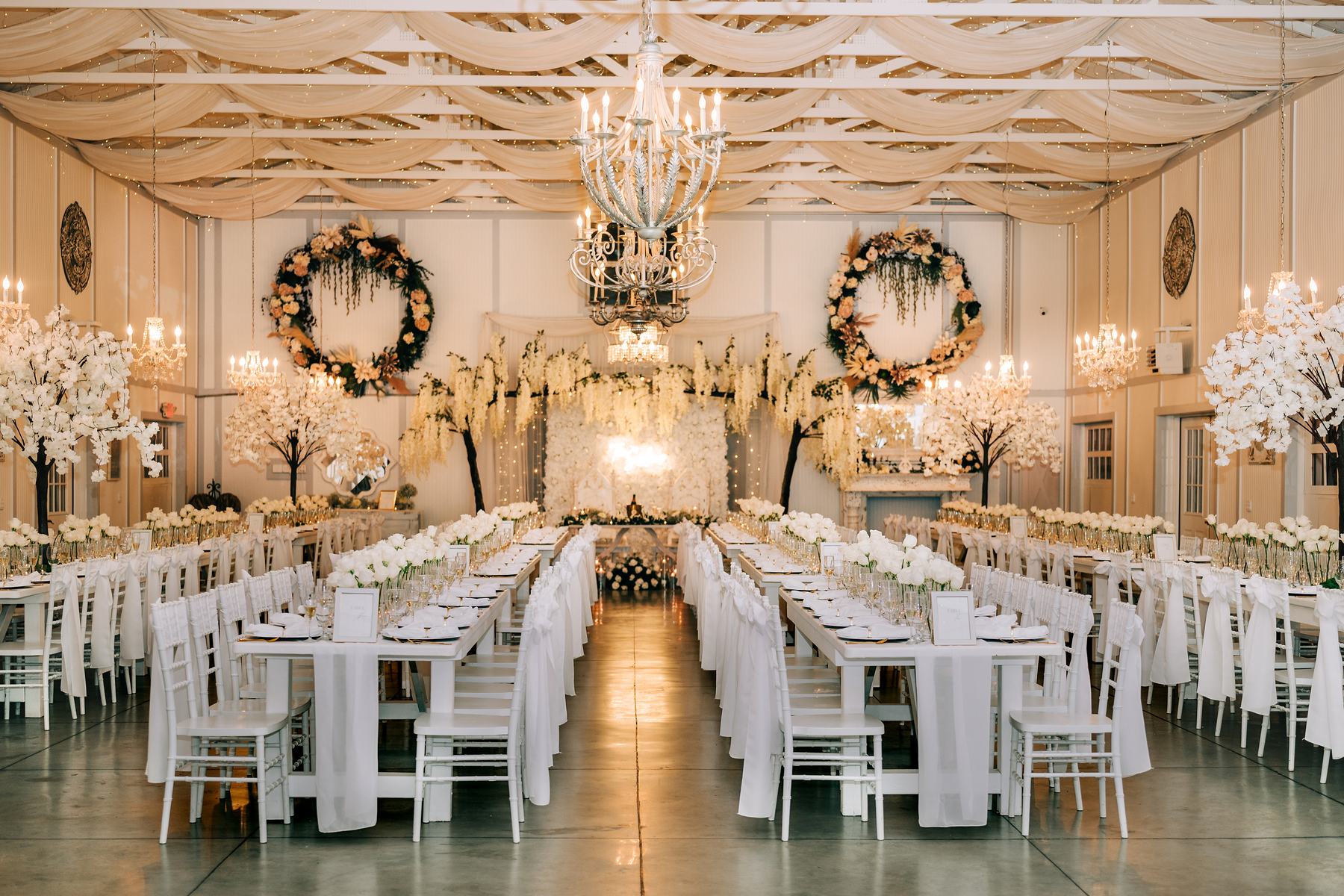
Get barn wedding lighting right by layering natural light, string light, and uplighting in that order.
Barn lighting works when it changes with the day. Here’s how to layer it at the Barn so your photos and your dance floor both hold up.
4.9 · 1,400+ Google reviews Three venues, one estate Booking 2027 & 2028
Start With What’s Already There
Natural light is the first lighting decision you make, not the last.
The Barn has large windows and high open beams, which means the barn is bright through most of the afternoon without any fixture turned on. If your ceremony is early or mid-afternoon, that daylight is doing the work — soft, even, and free. The mistake couples make is planning their lighting around the reception and forgetting the ceremony has its own light, and it’s the light your photographer will use for every ceremony shot. Work backward from your ceremony time before you pick a single string light or uplight color.
Brooksville sits far enough south that daylight holds later into the evening for most of the year than couples expect coming from farther north. That gives you a wider window for an outdoor or window-lit ceremony than a venue without that orientation. If you want portraits with real daylight on faces rather than flash, build a 20-30 minute gap between ceremony and reception specifically for that light, and tell your photographer the time so they can plan around it rather than react to it.
The trade-off is real: the same big windows that give you free daylight at 2pm go dark by dinner, and dark barn windows at night read as flat black behind your head table unless you’ve planned for it. Curtains, string light along the window line, or simply timing toasts before full dark all solve this. None of it is expensive. All of it has to be decided before the day, not discovered on it.
Building The Evening Layer
Reception lighting works in three layers, and skipping one shows.
The first layer is overhead — string lights across the beams, which is the look most people picture when they picture a barn wedding. It’s soft, it’s flattering, and it reads well in every photo without additional equipment. The second layer is uplighting along the walls, which is what gives the room color and depth instead of just brightness. Skip this layer and the barn looks lit but flat; add it and the same room reads as built for the evening rather than switched on for it.
The third layer is task lighting — light on the cake table, the bar, the sweetheart table, wherever guests need to see clearly rather than just feel the mood. This is the layer people forget because it’s not photogenic on its own, but it’s the layer that keeps a toast from happening in shadow or a cake cutting from looking underlit in every photo you paid for. A room with beautiful ambient light and no task light photographs worse than a plainer room lit correctly.
Color is where couples either commit or hedge, and hedging is usually the wrong call. Warm white uplighting works with almost every palette and ages well in photos years later; a bold accent color works with a specific palette and dates the photos to a trend. If you’re not sure, warm white is the safer default for a barn, because the wood tone in the room already does the warm work — you’re adding light, not competing with the material.
What Actually Changes By Season
Sunset time is the real variable, not the season name.
Couples plan around “spring wedding” or “fall wedding” when the number that actually matters is the sunset time for your specific date. A wedding booked for an early evening ceremony in December is working with a very different light window than the same start time in July, even though both are technically “barn weddings in Brooksville.” Pull the sunset time for your date before you set your ceremony hour, not after — it’s a five-minute search and it changes every other lighting decision downstream of it.
This matters most for the transition moment — the point where the room goes from ceremony light to reception light. Get the timing wrong and guests notice the room “go dark” mid-cocktail hour with nothing yet turned on to replace it. Get it right and the shift from daylight to string lights to uplighting feels intentional, because it is. Your coordinator should be building this transition into your day-of timeline as its own line item, not leaving it to whoever happens to be near the light switches.
None of this requires guessing at what’s technically possible in the room. The Barn’s team runs this same transition for every wedding it hosts, which means the lighting layers described here aren’t a design concept you’re introducing for the first time on your date — they’re a sequence the room and the staff already know how to run. Your job is to pick the palette and the hour; the execution is not new territory for anyone working your wedding.
A Simple Sequence
Here’s the lighting order that holds up from ceremony to last dance.
-
Set the ceremony hour first.
Choose your ceremony time based on the sunset for your date, not a generic time slot. This decision sets every other lighting choice that follows.
-
Plan the portrait gap.
Build a 20-30 minute window right after the ceremony for daylight portraits, before the light you’re relying on disappears.
-
Layer string light and uplighting.
String light overhead sets the base mood; warm-white uplighting along the walls adds depth without fighting the wood tones already in the room.
-
Add task light last.
Confirm the cake table, bar, and sweetheart table each have direct light, so the moments guests are watching aren’t sitting in shadow.
Related Reading
A few pages that go deeper on the pieces this one touches.
More on design
Styling the room you picked.

Booking 2027 & 2028
Come walk it before you decide anything.
A tour takes about an hour. You’ll see all three venues, the Bridal Suites, and leave with real pricing for your date and guest count — not a brochure.
- No-pressure tour
- Real numbers on the day
- 4.9 · 1,400+ reviews
- Rather just talk 813-909-3414 We answer the phone.
- Quick question Text us Send your date, we’ll reply.
- Coming to see us Get directions 45 min from Tampa.
103 S Saxon Ave., Brooksville, FL 34601 · 45 minutes from Tampa · 90 minutes from Orlando